When Your Contractor Changes Hands: Craft Labor, Consolidation, and Capital Project Risk
By Robert Reavis, Director, ButcherJoseph & Co.
For most of the last decade, owners could treat craft labor availability as their contractor’s problem. You prequalified on safety, bonding, financial strength, and relevant experience, and you assumed a qualified firm would find the people. That assumption is weaker than it used to be, and the contractor market is reorganizing itself in response. The firms competing for your work are increasingly buying each other to acquire crews, and that activity has consequences for the owners whose projects those crews are supposed to staff.
The Constraint is Structural, Not Cyclical
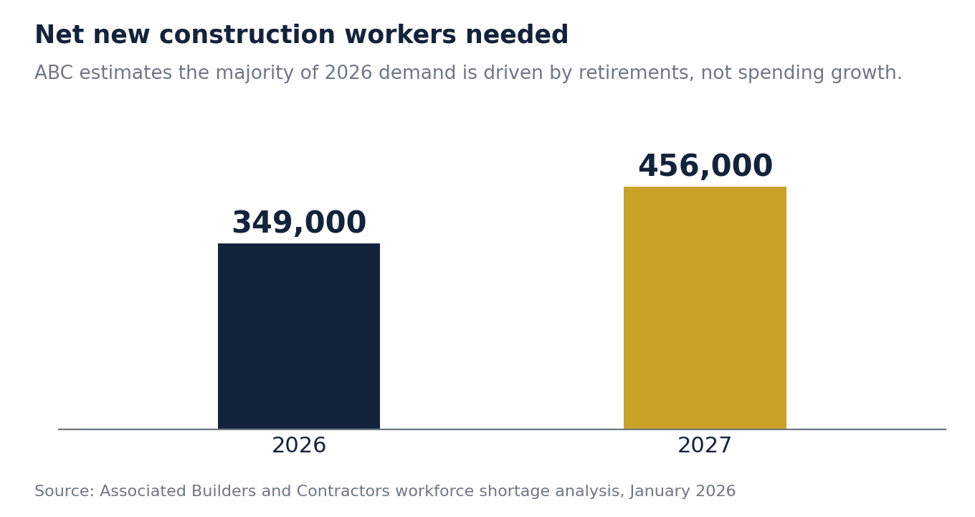
Associated Builders and Contractors estimates the industry needs roughly 349,000 net new workers in 2026 and another 456,000 in 2027. The composition of that number matters more than its size. ABC attributes the majority of the demand in 2026 to retirements rather than to growth in construction activity, which means the gap persists even in a flat spending environment. The average U.S. construction worker is over 42, and the bench behind the current generation of foremen and superintendents is thin.

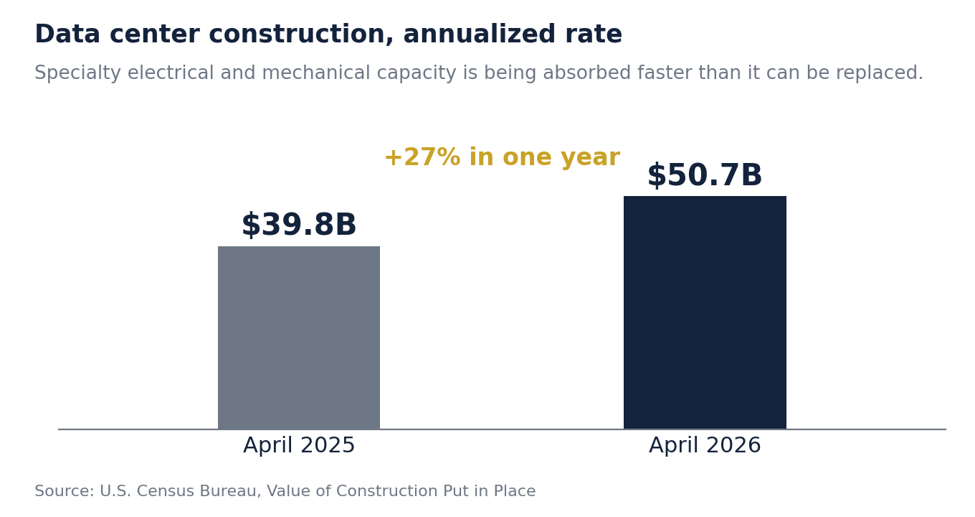
Demand has not politely adjusted to the available supply. Census Bureau data put data center construction at a $50.7 billion annualized rate in April 2026, up from $39.8 billion a year earlier, and that work absorbs electrical and mechanical capacity at a rate that crowds out other programs.
Bureau of Labor Statistics data showed unfilled construction positions above 224,000 in mid-2026, with the job openings rate at 3.5 percent against 2.6 percent a year earlier.
The practical effect for owners is that labor, not contractor appetite, now sets the ceiling on execution. A contractor can want your project, price it honestly, and still be unable to staff it at the density your schedule assumes. Craft availability has become a scheduling input rather than a background condition.
Contractors Are Buying Crews
When hiring cannot close the gap, acquisition becomes the fastest reliable route to capacity. Construction services M&A grew for a third consecutive year in 2025, with more than 560 announced or closed transactions, an increase of over 18 percent. Private equity remains the most active buyer group, executing buy and build strategies across specialty trades and engineering firms.
What is being purchased in many of these deals is not revenue or backlog – it is an intact field organization: licensed tradespeople, working crew structures, a functioning safety culture, and project leadership that would take a decade to build through recruiting. The activity concentrates where competition for craft is fiercest, which is electrical, mechanical, HVAC, and concrete. Those are precisely the trades most owners depend on for critical path work.
What Changes on Your Project
Ownership change at a contractor is rarely treated as an owner risk, and it should be. Four things tend to follow a transaction.
The integration period is real. Back-office systems, project controls, and estimating standards get rationalized over 12 to 24 months. Reporting that was reliable before the deal can get noisy during it.
Key people become mobile. The superintendent and project manager you selected the firm for may have signed a retention agreement or may not have. Sophisticated buyers structure around this risk with retention arrangements and earnouts tied to workforce stability, because they know that crews walking out the door after closing destroys the asset they bought. Owners carry the same exposure with less visibility into it.
Capital structure shapes behavior. A newly leveraged platform has debt service obligations that an independent, founder owned contractor did not. That can sharpen pricing discipline, and it can also change how a firm allocates scarce crews across a portfolio of clients when it has to protect earnings.
Crew allocation becomes a portfolio decision. Inside a roll up, your project competes for the same people as every other project on the platform. Where you sit in that queue is a function of your relationship, your program size, and your terms.
Ownership Structure Has Become a Retention Variable
Because retention is the mechanism that preserves craft capacity, ownership structure is now a legitimate diligence topic rather than a piece of trivia about your contractor’s capital stack.
Employee ownership is the clearest example. Nearly 1,000 construction companies now operate as ESOPs, covering more than 200,000 employee owners. A 2026 National Center for Employee Ownership survey found voluntary quit rates at ESOP companies averaging 11 percent against roughly 26 percent across U.S. companies generally, and 85 percent of respondents said employee ownership improved their ability to attract and retain people.
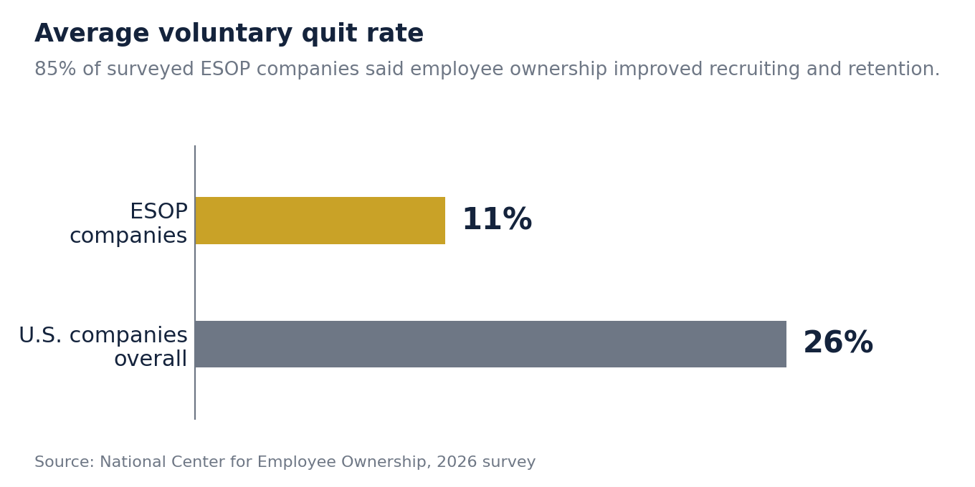
This is not an argument that employee-owned contractors are categorically better builders. It is an argument that turnover data and ownership stability belong in prequalification alongside experience modification rate and bonding capacity, because they predict whether the organization you evaluated will be the organization that shows up.
CURT’s own Labor Risk Management Program and the Construction Labor Market Analyzer exist to support exactly this kind of forward labor planning. The point is to use them before a transaction or a regional labor squeeze becomes a schedule problem, rather than after.
Owners also have more influence here than they typically exercise. Multiyear program agreements and reasonably predictable pipelines allow a contractor to hire and train ahead of demand. One off, lowest price awards do the opposite. If owners want contractors to invest in apprenticeship and retention, the contracting model has to reward the firms that do.
For Contractor Leadership
The same dynamic runs in reverse. If you are running a contracting business, your workforce has quietly become the asset buyers underwrite most closely. Diligence now scrutinizes tenure distributions, wage competitiveness, safety records, apprenticeship throughput, and succession depth in field leadership with the rigor once reserved for backlog and bonding.
Firms that can document low field turnover and a developed craft pipeline defend premium valuations. Firms that cannot get discounted for uncertainty, regardless of their revenue. Whether the path ahead is a sale, a recapitalization, or a transition to employee ownership, that story has to be built and documented well before it is told.
The Shift Worth Internalizing
The demographic math will not improve soon, and training infrastructure takes years to scale. The scarce asset in construction has moved from capacity to people, and the market is pricing it accordingly, both in deal multiples and in who gets crews on which jobsite next quarter. Owners who treat craft labor as a sourcing problem they can influence, rather than a condition they inherit, will be the ones whose schedules hold.
Here are some questions worth adding to prequalification:
- Who owns the firm today, and has control changed in the last three years? Is a transaction currently contemplated?
- What is voluntary turnover in the field, by trade, for the last three years?
- How many apprentices are in the pipeline, and what is the completion rate?
- What is the tenure distribution among foremen and superintendents, and how deep is the bench behind the people named on our project?
- If the firm is private equity backed, how are crews allocated across the platform, and where do we stand in that process?
- Do we have a change of control notice provision in the contract, alongside key personnel clauses with real remedies?


Rob Reavis is a Director at ButcherJoseph & Co., a St. Louis-based investment bank advising privately held and employee-owned companies on mergers and acquisitions, ESOP transactions, recapitalizations, and valuations, with significant experience across construction and the specialty trades.